
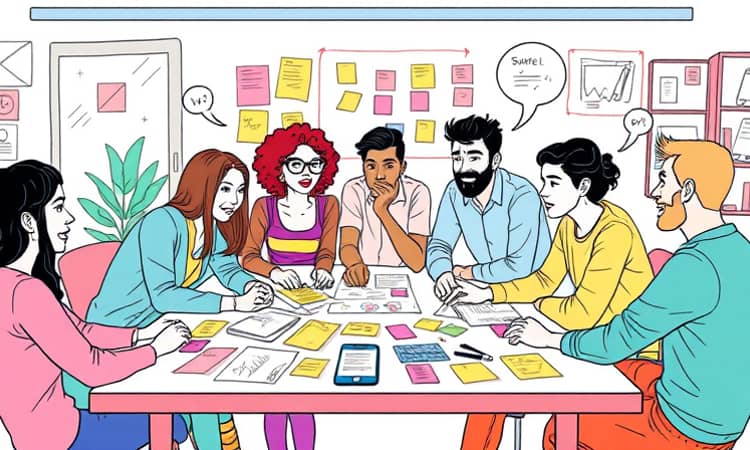
Design Thinking revolutionizes how we approach challenges by placing the human experience at the forefront.
Emphasizing empathy and user needs, this methodology transforms problem-solving into an art of innovation.
At its core, Design Thinking is about understanding people deeply.
It integrates creativity with practicality to develop solutions that are not only feasible but also desirable.
The process was popularized in the 1990s by pioneers like Tim Brown and David Kelley.
Their work at IDEO set the standard for applying design principles to business and beyond.
This approach is iterative and non-linear, allowing for continuous improvement.
Teams can revisit stages based on feedback, ensuring that solutions evolve with user insights.
By fostering a culture of experimentation, Design Thinking empowers organizations to adapt and thrive in a changing world.
Definition and Core Concept of Design Thinking
Design Thinking is defined as a human-centered innovation methodology.
It focuses on solving complex problems by developing creative solutions that prioritize user perspectives.
The term originates from the English phrase "thinking in the process" or "design thought".
It emphasizes putting the user at the center of product, service, and process development.
Tim Brown, CEO of IDEO, provides a classic definition.
He calls it "an approach to innovation centered on the human being, based on the design toolkit."
The fundamental pillars include empathy, experimentation, and prototyping.
These pillars guide the entire process from start to finish.
This methodology is practical, collaborative, and solution-oriented.
It is applicable to various domains like products, services, education, and marketing.
The key elements that make Design Thinking effective are:
- Empathy: Deeply understanding user emotions and experiences.
- Experimentation: Rapid testing of ideas to learn and adapt.
- Prototyping: Creating tangible models to visualize solutions.
Key Stages of the Design Thinking Process
The process typically follows five main stages, often visualized with the Double Diamond model.
This model shows expansion and contraction phases for idea generation and refinement.
Here is a detailed overview of the stages in a table format:
The process is not strictly linear; it encourages iteration.
Teams often move back and forth between stages based on insights gained.
Variations exist, such as the four-stage model used by ESPM.
Other models include implementation as an additional step after testing.
Benefits and Advantages of Design Thinking
Design Thinking offers numerous benefits that make it a powerful tool for innovation.
It generates user-adapted innovative solutions that are both viable and executable.
Some key advantages include:
- Improved understanding of customers, leading to faster market adaptation.
- Reduced risks through low-cost prototypes that detect problems early.
- Promotion of interdisciplinary collaboration and creativity within teams.
- Applications across various fields, from business to education and marketing.
- Measurable results that balance desirability, feasibility, and viability.
By focusing on empathy, it ensures that solutions truly meet user needs.
This human-centered approach minimizes waste and maximizes impact.
It fosters a culture of continuous learning and adaptability.
Organizations that embrace Design Thinking often see enhanced team morale and innovation rates.
Practical Examples and Applications
Design Thinking is applied in diverse contexts to drive innovation.
In business practice, teams use it to simplify product creation with agile iterations.
For example:
- Companies like OBRA apply Design Thinking in agile solutions for efficient project management.
- In education, it develops skills through investigative learning, sparking curiosity and critical thinking.
- Consultancies use it to solve complex human-centered problems in healthcare and social services.
- Marketing teams leverage it to create campaigns that resonate deeply with target audiences.
The process is dynamic, allowing for flexibility and adaptation.
This non-linear nature fosters continuous learning and improvement across all applications.
Tools like empathy maps and brainstorming sessions support this iterative journey.
History, Origin, and Key Authors
Design Thinking was popularized in the 1990s by IDEO, led by Tim Brown and David Kelley.
They unified existing design methods to foster collective creativity and efficiency.
It evolved from traditional design practices into a broad business philosophy.
Today, more companies adopt it for user-centered innovation in a competitive landscape.
Key figures in its development include:
- Tim Brown, who defined the methodology and advocated for its business applications.
- David Kelley, co-founder of IDEO and a pioneer in integrating design with engineering.
- Other contributors who expanded its use in education and social innovation.
This historical context shows how Design Thinking has grown from a niche concept to a global standard.
Tips for Application and Advanced Contexts
To successfully apply Design Thinking, consider these practical tips.
Embrace its non-linear and iterative nature for constant experimentation and adaptation.
Important aspects to keep in mind include:
- Involve multidisciplinary teams with diverse perspectives from consumers to suppliers.
- Focus on innovation by shifting mindset to user-centric problem-solving in all projects.
- Be aware of limitations, such as the need for dedicated initial research and resources.
- It is ideal for "ill-defined" problems where traditional methods fall short, like social issues or new product development.
- Maintain a balance between creativity and feasibility to ensure sustainable solutions.
While quantitative data might be limited, the qualitative efficiency is proven through case studies.
This approach transforms how organizations innovate and adapt to changing environments.
By implementing these tips, you can harness the full potential of Design Thinking in your work.
In conclusion, Design Thinking is more than a methodology; it's a mindset that empowers humanity to solve complex challenges.
By prioritizing human needs and fostering collaboration, it enables groundbreaking solutions to emerge, inspiring innovation everywhere.
Referências
- https://www.alura.com.br/artigos/design-thinking-metodologia-criacao-de-produtos
- https://blog.obra.ag/design-thinking-na-pratica-solucoes-inovadoras-em-
- https://www.iade.europeia.pt/blog/design-thinking-marketing/
- https://conteudo.saraivaeducacao.com.br/desenvolvimento-profissional/design-thinking/
- https://weshine.com.br/criatividade/metodologia-design-thinking/
- https://www.iberdrola.com/talentos/design-thinking-metodologia
- https://www.espm.br/blog/design-thinking-o-que-e-e-como-funciona/
- https://fia.com.br/blog/design-thinking/
- https://www.docusign.com/pt-br/blog/design-thinking-o-que-e-como-funciona-e-quais-sao-vantagens
- https://revistas.ufpr.br/atoz/article/view/91948
- https://www.cesar.org.br/w/design-thinking
- https://www.vertieconsultoria.com.br/design-thinking-uma-abordagem-pratica-para-solucao-de-problemas-em-projetos-de-inovacao
- https://www.salesianos.pt/artigos/design-thinking-o-que-e-e-como-usar-essa-metodologia-em-sala-de-aula/
- https://tuia.design/design-thinking/